The winged figure
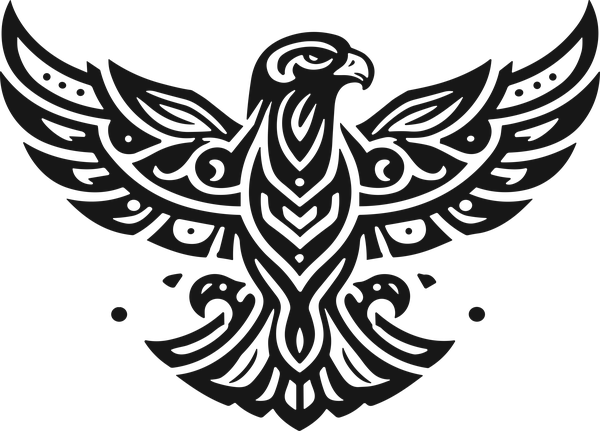
The Faravahar (فروهر) is the most recognisable symbol of ancient Iran. A bearded figure rises from a ring, one hand raised, the other holding a smaller ring. Beneath him spread two great wings, a tail of feathers and two curling streamers.
Its roots are older than Persia itself. The winged disc had been used across the ancient Near East for centuries, by the Egyptians and the Assyrians, as a sign of divine and royal power. The Persians took that idea and made it their own.
 II
IICarved in stone
Under the Achaemenid kings, from around 550 to 330 BC, the winged figure became part of the visual language of the empire. Darius the Great placed it above himself at Behistun, where he recorded his victories on a cliff face high above the road. It hovers over the kings in the reliefs of Persepolis and Susa, and above the royal tombs cut into the rock at Naqsh-e Rostam.
It always appears in the same place: above the king, never beside him. Whatever it stood for, it was something even a king looked up to.
IIIA meaning still debated
No record survives of what the Achaemenids themselves called it. Persian archives were lost in later conquests, and scholars still debate what it meant. Some have read it as Ahura Mazda, the supreme god of Zoroastrianism. Others see in it the farr, the divine royal glory carried by the Shahbaz. In Zoroastrian tradition it came to be known as the fravashi, the guardian spirit that accompanies every good soul.
Every age that inherited it found its own meaning in it.
IVWhat the Faravahar represents
Today, the most widely shared reading treats the Faravahar as a guide to living well. It is a modern interpretation, but one that has given the symbol new life.
The figure is the human soul, older and wiser, facing forward. His raised hand points the way towards goodness. The ring he holds is a promise kept, a sign of loyalty and faithfulness.
The ring at the centre has no beginning and no end, for the eternity of the soul. The two streamers below are the two paths open to every person, good and evil, and the choice between them is ours to make.
The wings carry three rows of feathers, for the three principles at the heart of Zoroastrian teaching: good thoughts, good words, good deeds. Humata, Hukhta, Hvarshta. The tail beneath has three rows too, for the bad thoughts, words and deeds the soul leaves behind as it rises.
VA symbol of Iran
After the fall of the Sasanian Empire in 651, the winged figure all but disappeared from Persian art for more than a thousand years. In the 20th century it returned. The Pahlavi dynasty adopted it in the 1920s as an emblem of Iran's ancient past, and it appeared on public buildings across the country.
Since 1979 it has not been an official emblem, yet it has become the best known symbol of Iranian identity. Iranians of every faith, and of none, wear it around their necks, keep it in their homes and give it to their children. It speaks of where they come from, not only of what they believe.
VIIn our collection
The Faravahar comes to our collection first as cufflinks, in black enamel and gold. Like every symbol we make, it is offered as a connection to Persian heritage, not as a religious statement.